
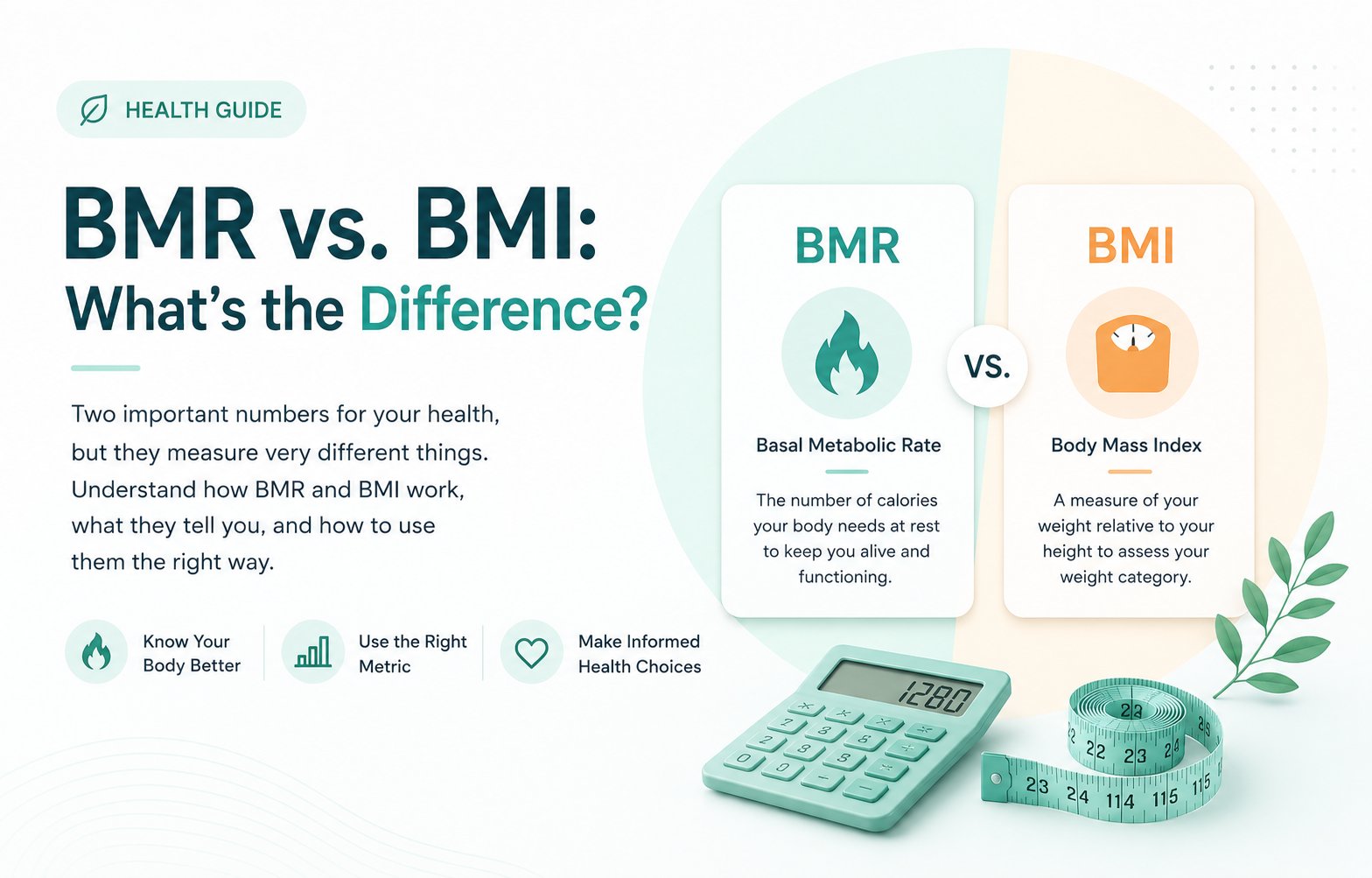
BMR vs. BMI: What’s the Difference?
BMR and BMI are both useful health-related calculations, but they answer very different questions. BMR estimates the energy your body needs at rest, while BMI compares body weight with height as a population-level screening measure.
What is BMR?
Basal Metabolic Rate
BMR is the estimated number of calories your body uses at rest to support essential functions such as breathing, circulation, temperature regulation and organ activity.
What it measures
BMR estimates resting energy expenditure. It does not include exercise, walking, digestion or other daily activities.
What is BMI?
Body Mass Index
BMI is a number calculated from weight and height. It is used to screen for weight categories that may be associated with health risk in adults.
What it measures
BMI measures weight relative to height. It does not directly measure body fat, muscle, fitness or individual health.
How are they calculated?
BMR: an estimate
Calculators commonly use an equation based on age, sex, height and weight, such as the Mifflin–St Jeor equation. Results are estimates, not a laboratory measurement.
BMI: a ratio
For adults using metric units, divide weight in kilograms by height in metres squared.
Key differences
| Feature | BMR | BMI |
|---|---|---|
| Main purpose | Estimate resting energy needs | Screen weight relative to height |
| Uses | Age, sex, height and weight; equation-dependent | Weight and height |
| Result | Estimated calories per day | A numerical index |
| Useful for | Planning energy intake and understanding metabolism | Initial population-level risk screening |
| What it cannot show | Exact daily calorie needs or complete metabolic health | Body-fat percentage, muscle mass or diagnosis |
When is each metric useful?
Use BMR when you want to…
- Understand your approximate resting energy needs.
- Estimate total daily energy needs by adding activity and other factors.
- Set a starting point for an evidence-informed nutrition plan.
Use BMI when you want to…
- Get a quick adult weight-to-height screening result.
- Track broad changes over time alongside other measures.
- Discuss weight-related health risks with a qualified professional.
Limitations and correct interpretation
BMI is a screening tool, not a diagnosis. It can misclassify people with high muscle mass and may not reflect differences in body composition, age, ethnicity or fat distribution. Adult BMI categories should not be applied to children and teenagers; their results require age- and sex-specific growth charts.
BMR is an estimated energy requirement, not a direct health measure. Equations cannot capture every factor affecting metabolism, and actual energy needs vary with activity, body composition, illness, medications and other circumstances.
Which one should you use?
Choose BMR if your question is, “How much energy might my body need at rest?” Choose BMI if your question is, “How does my weight compare with my height?” Many people can use both, but neither replaces a complete health assessment or personalised medical advice.
Explore the VinkaMetrics calculators
Use these calculators as convenient starting points, then interpret the results with the limitations above in mind. Explore the BMR calculator → or BMI calculator →.